
…targets trillions in untapped maritime wealth
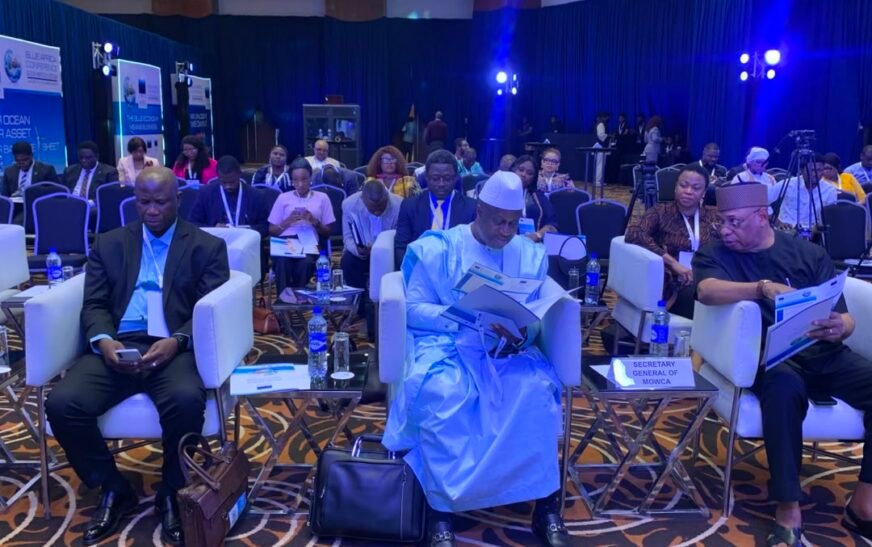
The Maritime Organisation of West and Central Africa (MOWCA) has launched the maiden Blue Africa Conference and Exhibition 2026 in Nigeria, challenging African governments and businesses to move beyond rhetoric and turn the continent’s vast marine resources into engines of investment, jobs and sustainable economic growth.
The two-day conference and exhibition, which began on Thursday at the Lagos Continental Hotel, Victoria Island, Lagos, brings together policymakers, maritime operators, investors, technology providers and other stakeholders to examine practical pathways for unlocking Africa’s blue economy.
The event, which ends on Friday, August 14, is focused on key areas including maritime trade, ports, fisheries, aquaculture, offshore energy, marine technology and coastal development.
MOWCA said the conference was conceived against the backdrop of growing global investment in ocean-based industries and the urgent need for African countries to secure a larger share of the economic value generated from their marine resources.
The organisation argued that Africa could no longer afford to remain largely a supplier of raw maritime and marine resources while technology, processing, financing and much of the resulting wealth were created outside the continent.
According to the organisation, the challenge is not a lack of resources but the continent’s limited capacity to develop the infrastructure, institutions, technology, skills and investment partnerships required to fully exploit them.
It said the Blue Africa initiative was therefore designed as a long-term platform for connecting governments, businesses, investors, development institutions and coastal communities around bankable opportunities within Africa’s blue economy.
MOWCA said the conference would enable participating governments to showcase their national blue economy strategies, investment priorities, infrastructure needs, policy frameworks and specific projects to potential investors and strategic partners.
For investors and businesses, the organisation said the platform would provide access to emerging markets, policymakers and projects capable of delivering commercial returns while contributing to economic development.
The initiative also places strong emphasis on local value creation.
MOWCA stressed that Africa must increasingly develop the capacity to process, manufacture and provide services around its maritime resources rather than exporting opportunities along with the resources themselves.
The organisation’s position reflects a broader challenge confronting African economies: despite their enormous coastlines, inland waterways, fisheries, offshore resources and strategic position along major global shipping routes, many countries continue to capture only a fraction of the economic value associated with the maritime sector.
The Blue Africa platform, MOWCA said, is intended to change that narrative by bringing the various components of the blue economy into a common investment and policy conversation.
“Blue Africa is simply not just an event; it is the beginning of a long-term platform,” the association said, underscoring its intention to build an ecosystem capable of sustaining investment, innovation and cross-border collaboration.
Beyond Governments and Investors, MOWCA also highlighted the role of young Africans in the development of the sector, noting that the future blue economy would require a new generation of professionals in engineering, marine science, technology, logistics, law, finance, policy, entrepreneurship and communications.
The organisation said Africa’s maritime transformation could not be achieved solely through government policies or private capital, stressing the importance of building the human-capital base required to operate sophisticated marine and maritime industries.
It also announced plans to establish a media platform around the Blue Africa initiative, describing strategic communication and storytelling as essential tools for attracting investment and changing perceptions about Africa’s maritime potential.
The planned platform, according to MOWCA, will eventually incorporate television, print and digital media to showcase opportunities, connecting businesses with investors and giving African countries greater control over the narrative surrounding their marine resources.
The organisation believes stronger visibility could help bridge the gap between available opportunities and investors seeking viable projects across the continent.
The conference comes at a time when African countries are increasingly looking to the blue economy as a source of diversification, employment, foreign exchange and sustainable development.
For Nigeria, the world’s blue economy conversation has particular significance given its extensive coastline, ports, inland waterways, fisheries, offshore oil and gas assets and growing interest in marine transportation and offshore renewable energy.
However, experts have consistently argued that possessing maritime resources does not automatically translate into economic prosperity.
The real challenge lies in creating an ecosystem in which infrastructure, regulation, financing, technology and human capital work together to convert those resources into productive economic activities.
That is the gap MOWCA says the Blue Africa initiative seeks to address.
Rather than treating the maritime sector as a collection of isolated industries, the platform is expected to promote an integrated approach linking ports and shipping with fisheries, aquaculture, offshore energy, marine technology, coastal tourism and other ocean-based activities.
MOWCA said the ultimate objective was to help African countries attract investment, develop viable projects, create employment and retain a greater proportion of the wealth generated from their marine resources.
The organisation urged participants at the maiden conference to move beyond speeches and use the platform to forge concrete partnerships, identify investable projects and develop initiatives capable of delivering measurable economic outcomes.
It said the success of Blue Africa would ultimately be measured not by the number of conferences held, but by the investments mobilised, businesses created, jobs generated, technologies developed and value retained within African economies.
With the maiden conference now underway in Lagos, MOWCA is positioning Blue Africa as more than another maritime gathering, but as an attempt to build a continental investment ecosystem around one of Africa’s most underexploited economic frontiers—the ocean.